Home › Weed guide › Ground elder
Weed guide
Ground elder
Aegopodium podagraria · Carrot family (Apiaceae)
Also called bishop's weed or goutweed (New Zealand and North America), snow-on-the-mountain (the variegated garden form).
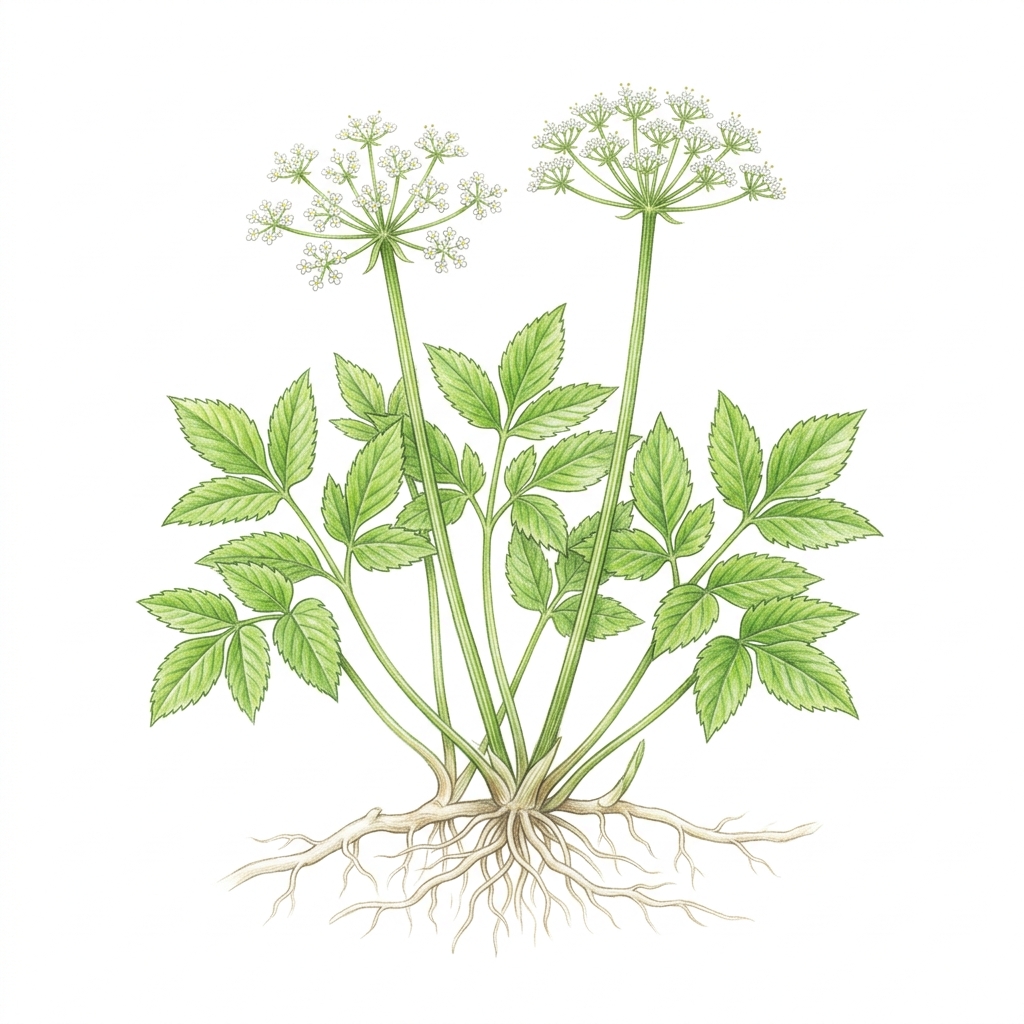
Illustration
A carpet of leafy ground cover with flat white flower heads that creeps through borders on shallow white roots. Every root piece regrows, so it takes steady, repeated removal over a few years.
How to spot it
- Leaves on long stalks, each divided into three groups of three leaflets (upper leaves have just three).
- Leaflets oval, pointed and toothed, 2.5–8 cm long, often only partly separated.
- A dense carpet 30–60 cm tall, with hollow, grooved flower stems up to 1 m.
- Flat white flower heads 6–12 cm across in summer, with no small leafy bracts beneath them.
- Shallow white or cream creeping roots that smell of carrot when broken.
Easily confused with
Poison hemlock
Deadly: finely divided, fern-like leaves and a smooth stem with purple spots.
Elder seedlings
Woody stems, and leaves in opposite pairs with five to seven leaflets.
Wild carrot
Feathery leaves, bracts under the flower head, and often a single purple flower in the middle.
Where it's a problem
- United Kingdom: Brought in long ago, and now a common and invasive garden weed.
- Australia: Naturalised in Victoria, NSW and Tasmania.
- New Zealand: Naturalised since the 1940s.
- North America: Restricted or prohibited in several US states, including Vermont, Connecticut and Wisconsin.
What to do
- Pull or cut new growth again and again: each time weakens the roots.
- Fork out the roots, which are shallow (mostly in the top 15 cm), and sift the soil for pieces.
- In a planted border, lift your plants, pick every weed root out of them, and replant.
- Smother bare areas for a few years under cardboard and about 20 cm of mulch, or under weed fabric.
- Sink a root barrier about 45 cm deep to stop it creeping back in, and mow it where it meets a lawn.
If you use a herbicide, choose one labelled for ground elder and follow the label and local rules. The RHS doesn't support using weedkillers on it; where they are used, several treatments are usually needed.
Follow your local council's guidance for disposing of weeds. Councils usually advise against putting weeds like this in the green waste / vegetation bin or the compost.
Take care: The real danger is confusing it with poison hemlock, which is deadly.
Free account, no card needed. You sign up or sign in first, then the scanner opens.
Sources
- RHS: Ground elder
- Botanical Society of Britain and Ireland
- VicFlora, Royal Botanic Gardens Victoria
- Flora of New Zealand: Aegopodium podagraria
- Wisconsin DNR: Bishop's goutweed
- Washington State Noxious Weed Control Board: Goutweed
- Penn State Extension: Poison hemlock
Facts checked Sunday 27 September 2026. General guidance only: follow your local council, agency and product label.