Home › Weed guide › Giant hogweed
Weed guide
Giant hogweed
Heracleum mantegazzianum · Carrot family (Apiaceae)
Also called giant cow parsnip (North America), cartwheel flower (Australia and New Zealand).
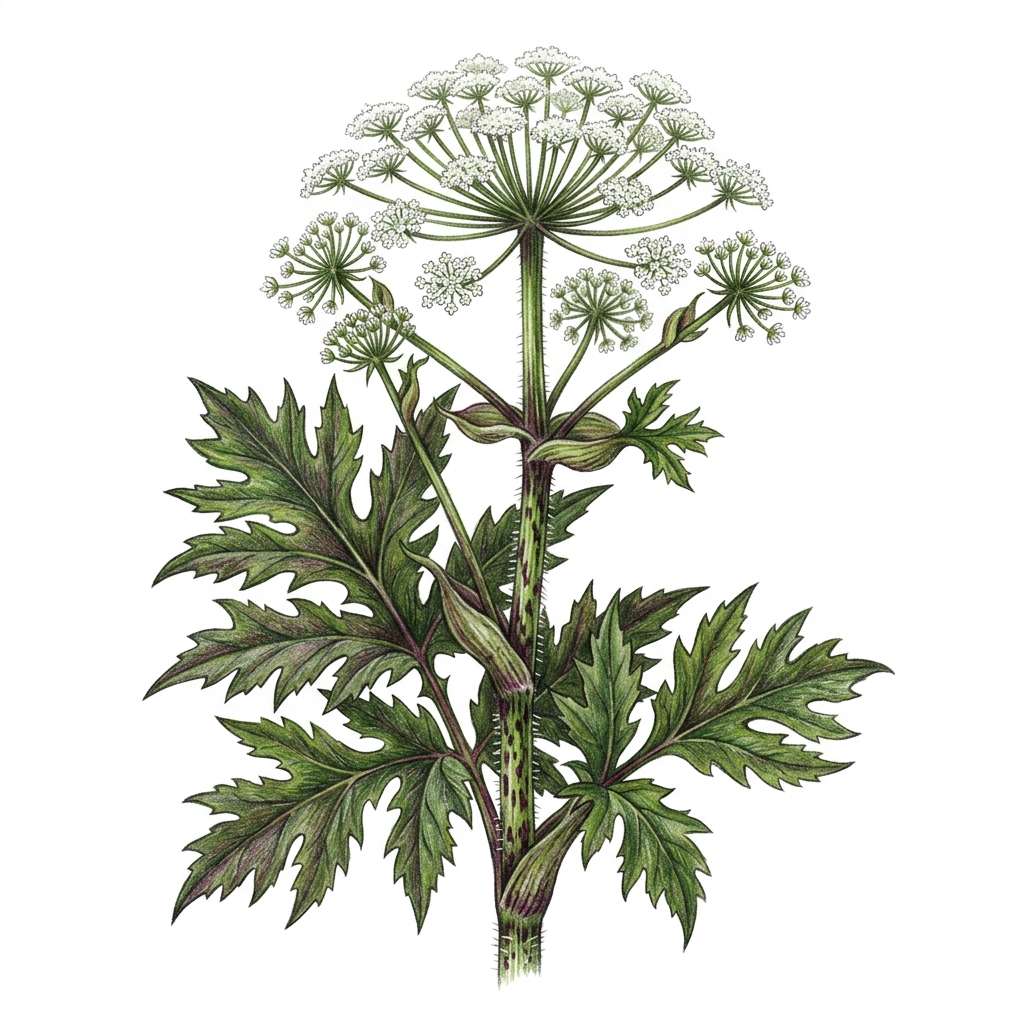
Illustration
A towering relative of cow parsley, up to 5 m tall, whose sap causes severe burns and blisters when the skin is then exposed to sunlight. Don't touch it with bare skin, and never strim it.
How to spot it
- Huge: usually 2–5 m tall when flowering.
- A thick, hollow, ridged stem 5–10 cm across, green with dark purple blotches and coarse white bristles.
- Enormous jagged leaves, deeply cut into pointed lobes, up to 1.5 m wide.
- Flat-topped white flower heads like umbrellas, 60–80 cm across, in early summer.
- Flat, oval seeds about 1 cm long with dark stripes.
Easily confused with
Common hogweed
No purple blotches, under 2 m tall, with flower heads around 15 cm. Its sap can also irritate skin.
Cow parsley
Fine, fern-like leaves, and it flowers earlier in the year.
Cow parsnip (North America)
No blotches on the stem, soft fuzzy hairs, and flower heads under 30 cm.
Where it's a problem
- United Kingdom: Widespread. It's an offence to plant it or cause it to grow in the wild, and cut material is controlled waste.
- USA: A Federal Noxious Weed: illegal to import or move between states without a permit.
- Canada: On Ontario's list of noxious weeds.
- New Zealand: Naturalised; an unwanted organism that can't be sold, propagated or distributed.
- Australia: Not established; declared in Tasmania and Western Australia. Report any sighting.
What to do
- Keep children and pets away, and never touch it with bare skin.
- If you tackle small plants yourself, wear waterproof gloves, long sleeves, long trousers and eye protection: sap on clothing and tools also burns.
- Never use a strimmer, brush cutter or chipper on it, and never burn it.
- Dig out young plants, cutting through the root below the crown so it can't regrow; cut off and bag flower heads before they set seed.
- For large plants, the RHS says a specialist removal firm is the safest option. Expect to repeat for several years as seedlings keep appearing.
If you use a herbicide, choose one labelled for giant hogweed and follow the label and local rules. Treatment works best in the growing season, before it flowers.
Follow your local council's guidance for disposing of weeds. Councils usually advise against putting weeds like this in the green waste / vegetation bin or the compost.
Take care: Sap plus sunlight causes burns, blisters and long-lasting scars, and sap in the eyes can damage sight. If sap touches your skin, cover it, wash it with soap and water as soon as you can, keep it out of the sun for at least 48 hours, and get medical advice if it reddens or blisters. For eyes, rinse with clean water and see a doctor.
Free account, no card needed. You sign up or sign in first, then the scanner opens.
Sources
- RHS: Giant hogweed
- GB Non-Native Species Secretariat: Giant hogweed
- GOV.UK: Invasive non-native plants
- New York State DEC: Giant hogweed
- US National Invasive Species Information Center
- Ontario Government: Giant hogweed
- Weedbusters NZ: Giant hogweed
- NRE Tasmania: Giant hogweed
- Government of Québec: Burns caused by giant hogweed
Facts checked Sunday 27 September 2026. General guidance only: follow your local council, agency and product label.