Home › Weed guide › Fleabane
Weed guide
Fleabane
Conyza bonariensis and Conyza canadensis · Daisy family (Asteraceae)
Also called flaxleaf fleabane (Australia), horseweed or marestail (Conyza canadensis; USA), Canadian fleabane (UK and Australia).
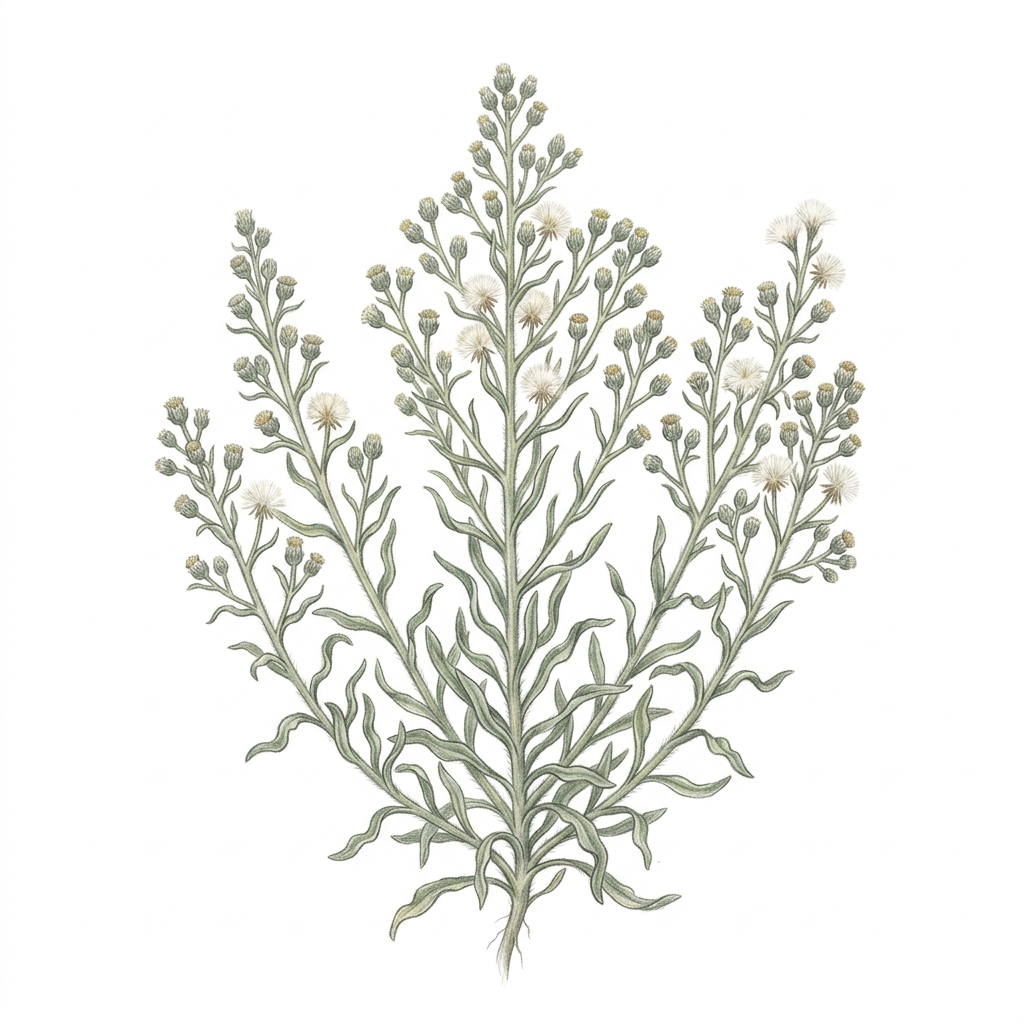
Illustration
A hairy, grey-green weed that shoots up in bare ground and along fences, each plant releasing more than 100,000 fluffy seeds. It resists several common weedkillers, so pull it young, root and all, before it seeds.
How to spot it
- Starts as a flat, hairy rosette.
- Flaxleaf fleabane: grey-green, very hairy, up to about 1 m, branching from the base with side branches growing taller than the centre, like a candelabra.
- Narrow leaves, often wavy or twisted; the lower ones 4–12 cm long with a few shallow teeth.
- Many tiny flower heads with no showy petals, ripening into white-to-pinkish fluff.
- Horseweed (Canadian fleabane): a single tall stem crowded with narrow leaves, branching only near the top, up to about 1.8 m.
Easily confused with
Tall fleabane
Up to 2 m and bright green, branching only at its pyramid-shaped flower head, with flat leaves.
Sowthistle
Yellow, dandelion-like flowers and milky sap.
Where it's a problem
- Australia: Flaxleaf fleabane is the most widespread and troublesome fleabane, made worse by weedkiller resistance; in NSW everyone has a general duty to limit its spread.
- USA: Horseweed is a major weed of orchards and vineyards, and a prohibited noxious weed in Ohio.
- Canada: Weedkiller-resistant Canada fleabane is confirmed across much of Ontario.
- United Kingdom: Canadian fleabane is turning up more and more in crops.
- New Zealand: Naturalised since the 1880s.
What to do
- Pull small plants before they seed, taking the root: it resprouts from the base if only the top is removed.
- Bag the seed heads before pulling larger plants, and wear gloves.
- Don't leave ground bare: its seed sprouts at the surface, so mulch and dense planting keep it down.
- Act early: large plants with a big taproot are very hard to kill by any method.
If you use a herbicide, choose one labelled for fleabane and follow the label and local rules. It has become resistant to several common weedkillers in Australia and North America, so spraying works best, if at all, on small rosettes.
Follow your local council's guidance for disposing of weeds. Councils usually advise against putting weeds like this in the green waste / vegetation bin or the compost.
Take care: Horseweed leaves and flowers can irritate skin, so wear gloves.
Free account, no card needed. You sign up or sign in first, then the scanner opens.
Sources
- GRDC: Integrated weed management of flaxleaf fleabane
- NSW DPI WeedWise: Fleabane
- VicFlora, Royal Botanic Gardens Victoria
- Florabase, Western Australian Government
- University of California IPM: Horseweed
- Iowa State University: Horseweed
- AHDB: Canadian fleabane in the UK
Facts checked Sunday 27 September 2026. General guidance only: follow your local council, agency and product label.