Home › Weed guide › Field bindweed
Weed guide
Field bindweed
Convolvulus arvensis · Morning glory family (Convolvulaceae)
Also called bindweed (UK and New Zealand), common bindweed (Australia), wild morning glory (USA).
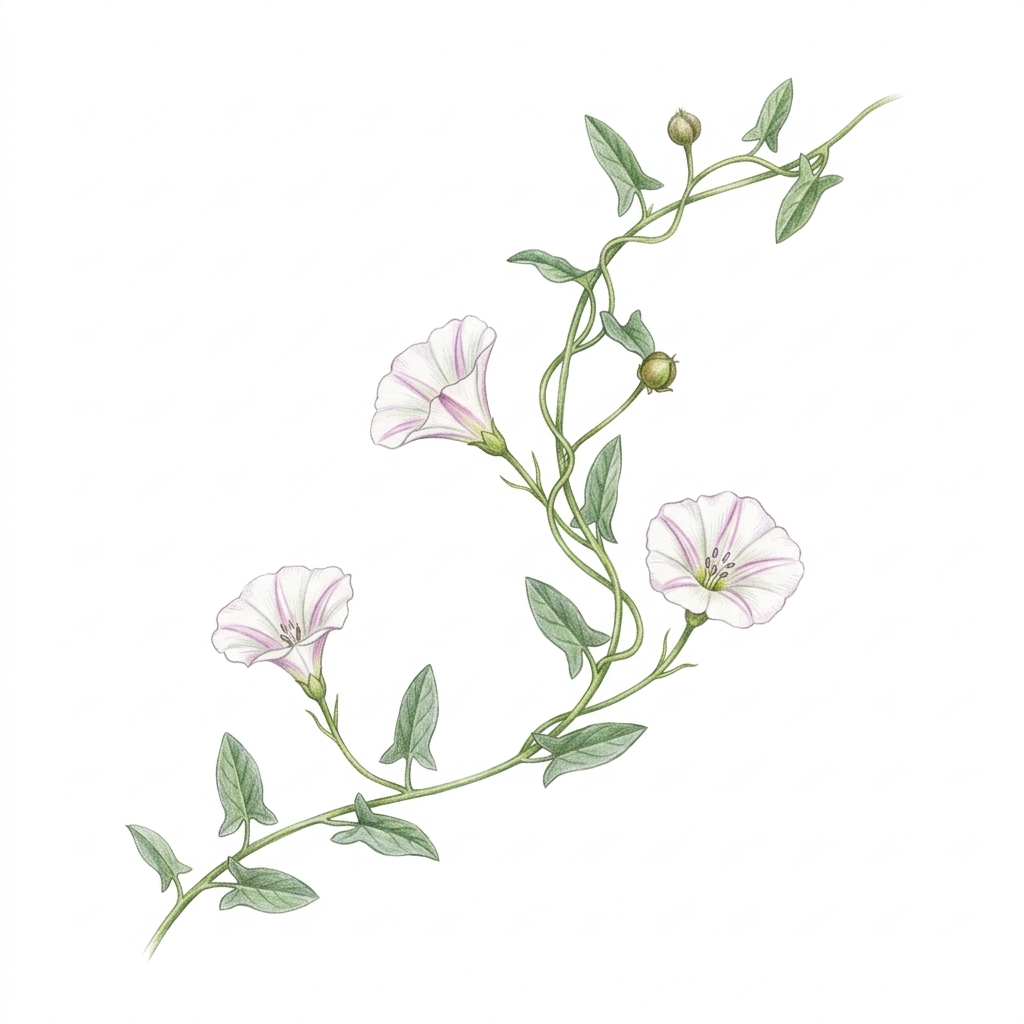
Illustration
A twining climber with pretty white-to-pink trumpet flowers and roots that can go metres deep. Broken pieces of root grow again, so it's beaten by patience: keep removing the shoots until the roots run out of energy.
How to spot it
- Arrowhead-shaped leaves 1.5–6 cm long, grey-green to dull green, growing one at a time along the stem.
- Funnel-shaped flowers about 2–3 cm across, white to pink and often striped pink; each flower lasts just one day.
- Two tiny thread-like bracts about 1 cm below each flower, not wrapped around it.
- Thin stems that twine around plants and fences or trail along the ground, up to about 2 m long.
- Small round seed capsules, 4–7 mm across.
Easily confused with
Hedge bindweed (Calystegia sepium)
Bigger all round: flowers about 5 cm across with two large leafy bracts wrapped around their base, and heart-shaped leaves up to 12 cm. In Victoria and New Zealand a pink-flowered form of it is a native plant, so check before you pull.
Wild buckwheat (Fallopia convolvulus)
An annual with a papery sheath around the stem where each leaf joins, and tiny green flower clusters.
Morning glories
Heart-shaped or three-lobed leaves and bigger, showier flowers about 5 cm across.
Where it's a problem
- United Kingdom: Native and common in gardens, and one of the most persistent weeds to clear.
- Australia: Found in every state except the Northern Territory; a declared weed in South Australia and Victoria.
- New Zealand: Common, but not a legally declared pest.
- North America: Once called the worst weed in California; in Canada its seed is a primary noxious weed seed.
What to do
- Pull or fork out seedlings early: they are easy to kill for only about three to four weeks after they appear.
- On established plants, keep removing every new shoot. It won't die in one go, but repeated removal slowly starves the roots.
- Don't dig or hoe through the roots unless you can get them all out: chopped roots break into pieces, and a piece as short as 5 cm can grow a new plant.
- Smother bare ground with cardboard under about 20 cm of mulch, or overlapping weed fabric, and leave it in place for years: the roots can survive more than three years without light.
- In lawns, regular mowing keeps it in check. A root barrier sunk about 45 cm into the soil helps stop it creeping in from next door.
If you use a herbicide, choose one labelled for field bindweed and follow the label and local rules. Expect to need several treatments, possibly over more than one year. The weedkillers that work on it can also harm garden plants they touch.
Follow your local council's guidance for disposing of weeds. Councils usually advise against putting weeds like this in the green waste / vegetation bin or the compost.
Take care: It is suspected of causing digestive problems in horses and pigs that eat it.
Free account, no card needed. You sign up or sign in first, then the scanner opens.
Sources
- RHS: Bindweed
- University of California IPM: Field bindweed pest notes
- Washington State University Hortsense: Field bindweed
- Penn State Extension: The bindweeds
- Weeds Australia: Field bindweed
- VicFlora, Royal Botanic Gardens Victoria
- PIRSA (South Australia): Field bindweed
- Auckland Council: Field bindweed
- NZ Plant Conservation Network: native pink bindweed
- Canadian Food Inspection Agency: Field bindweed
Facts checked Sunday 27 September 2026. General guidance only: follow your local council, agency and product label.