Home › Weed guide › Broad-leaved dock
Weed guide
Broad-leaved dock
Rumex obtusifolius · Knotweed family (Polygonaceae)
Also called broadleaf or bitter dock (USA and Australia).
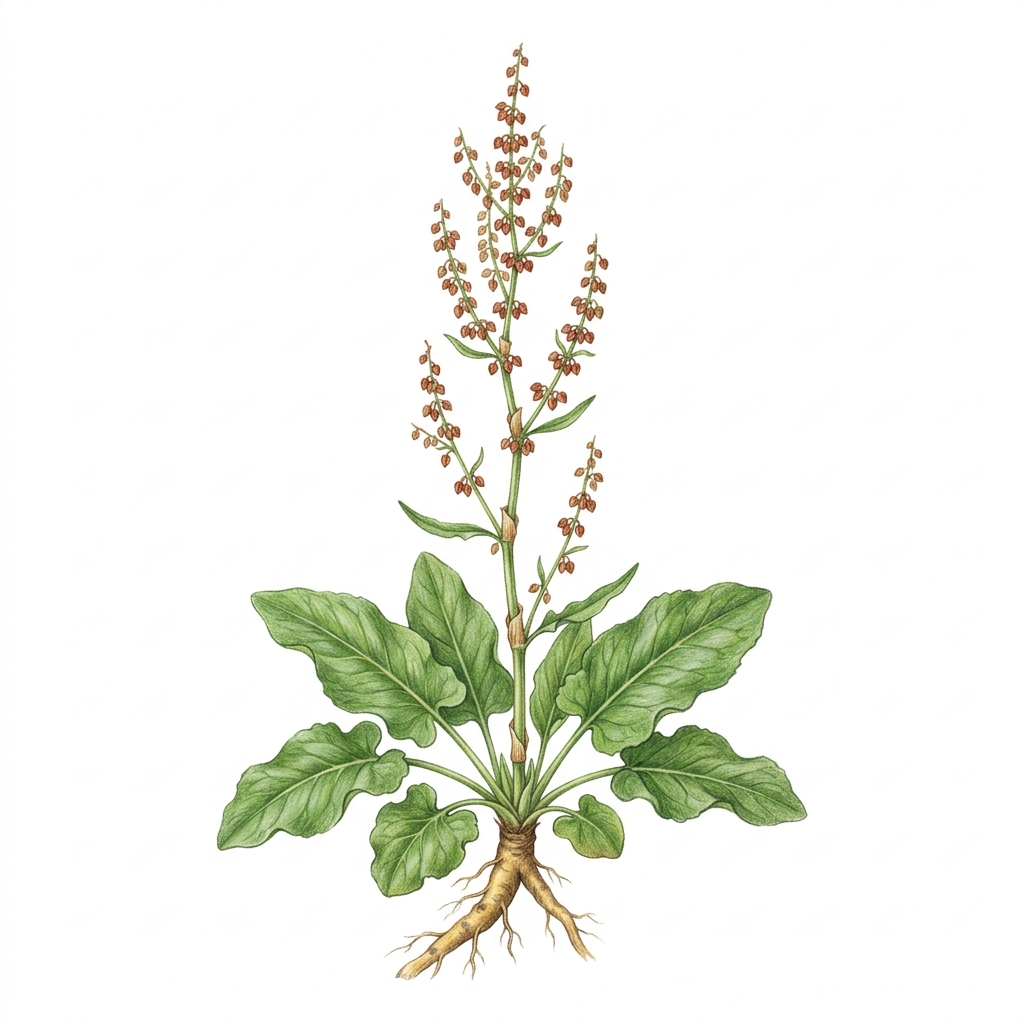
Illustration
Big, broad leaves and tall rusty-brown seed spikes, anchored by a thick yellow taproot. Dig out the top of the root and cut the flower spikes before they seed, and it gives up.
How to spot it
- A rosette of large oval leaves, about 25–35 cm long, with rounded lobes at the base and a strong central vein.
- Tall, loosely branched flower stems usually 1–1.2 m high, with clusters of small green flowers that turn reddish-brown and stay on into winter.
- A papery sheath where each leaf stalk meets the stem.
- Seed cases with a few small teeth on their edges.
- A thick, yellowish, often forked taproot.
Easily confused with
Curled dock
Much narrower leaves with very wavy, crinkled edges, and seed cases with no teeth.
Burdock (young rosette)
Woolly undersides to the leaves, and no papery sheath at the stem joints.
Where it's a problem
- United Kingdom: An 'injurious weed' under the Weeds Act 1959: you can have it on your land, but you should stop it spreading to neighbouring farmland.
- Australia: Not declared anywhere; mostly found in cooler southern areas.
- New Zealand: Common and widespread.
- North America: Widespread in pastures, gardens and along roadsides.
What to do
- Dig out the top 12–15 cm of the taproot: deeper pieces are unlikely to regrow.
- Hoe seedlings while they're young.
- Cut flower stems before they set seed; one plant can produce tens of thousands of seeds that last for decades.
- Mulch beds about 10 cm deep, or smother a patch under about 20 cm of organic matter.
- Expect a few flushes, as digging brings buried seed to the surface.
If you use a herbicide, choose one labelled for broad-leaved dock and follow the label and local rules. The RHS says there's no need to use weedkillers.
Follow your local council's guidance for disposing of weeds. Councils usually advise against putting weeds like this in the green waste / vegetation bin or the compost.
Take care: It contains oxalates and is suspected of harming livestock that eat large amounts.
Free account, no card needed. You sign up or sign in first, then the scanner opens.
Sources
- RHS: Docks
- Defra: Identification of injurious weeds
- GOV.UK: Stop ragwort and other harmful weeds spreading
- Weeds Australia: Broad-leaved dock
- Flora of New Zealand: Rumex obtusifolius
- Oregon State University: Broadleaf dock
- University of Maryland Extension: Dock
Facts checked Sunday 27 September 2026. General guidance only: follow your local council, agency and product label.