Home › Weed guide › Creeping thistle
Weed guide
Creeping thistle
Cirsium arvense · Daisy family (Asteraceae)
Also called Canada thistle (USA and Canada), Californian or perennial thistle (Australia and New Zealand).
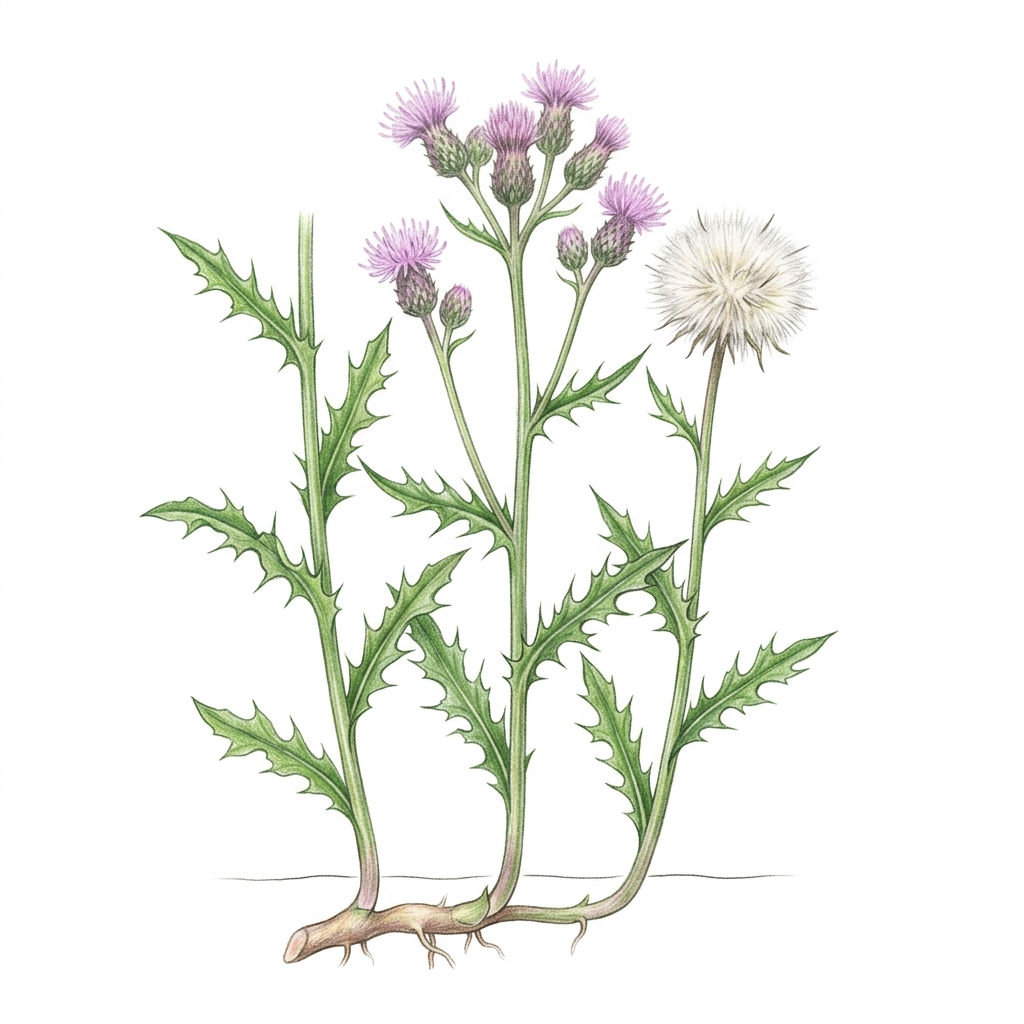
Illustration
Patches of spiny-leaved stems with small lilac-pink flowers, all joined underground by creeping roots. Digging spreads it; cutting it down again and again for a couple of years starves it out.
How to spot it
- Patches of many upright stems, usually 30–100 cm tall.
- Smooth stems with no spines or 'wings'.
- Narrow, wavy, lobed leaves with sharp spines along the edges.
- Small lilac-pink flower heads, about 1.5–2.5 cm, in loose clusters, smelling of honey.
- Fluffy thistledown seeds after flowering.
Easily confused with
Spear thistle
Spiny wings along the stem and much larger flower heads (3–5 cm); a biennial with a taproot and no creeping roots.
Nodding thistle
Large, usually single flower heads that droop.
Sowthistle
Yellow flowers and milky sap; despite the name, it isn't a true thistle.
Where it's a problem
- United Kingdom: Creeping and spear thistles are both 'injurious weeds' under the Weeds Act 1959: you should stop them spreading to neighbouring farmland.
- Australia: Declared in South Australia, Tasmania, Victoria and Western Australia (not NSW); in Tasmania its sale and distribution are prohibited.
- Canada: A noxious weed, both in national seed law and on Ontario's noxious weed list.
- USA: A prohibited noxious weed in Ohio.
- New Zealand: Widespread.
What to do
- Wear thick gloves: even the seedlings are prickly.
- Don't dig or hoe it: pieces of root as small as 1 cm can regrow.
- Instead, cut or pull off all the top growth every two to three weeks as it appears. It takes two to three years or more, but it starves the roots.
- Remove seedlings in their first few weeks, and cut off flowers before they seed.
- Mulch 10 cm deep, or smother a patch under cardboard and about 20 cm of organic matter for a few years.
If you use a herbicide, choose one labelled for creeping thistle and follow the label and local rules.
Follow your local council's guidance for disposing of weeds. Councils usually advise against putting weeds like this in the green waste / vegetation bin or the compost.
Take care: Very sharp spines: wear thick gloves.
Free account, no card needed. You sign up or sign in first, then the scanner opens.
Sources
- RHS: Creeping thistle
- Defra: Identification of injurious weeds
- Weeds Australia: Perennial thistle
- NRE Tasmania: Californian thistle
- Canadian Food Inspection Agency: Cirsium arvense
- Ontario Government: Noxious weeds
- Penn State Extension: Removing Canada thistle from the home garden
- Missouri Department of Conservation: Prickly sow thistle
Facts checked Sunday 27 September 2026. General guidance only: follow your local council, agency and product label.