Home › Weed guide › Blackberry
Weed guide
Blackberry
Rubus fruticosus agg. · Rose family (Rosaceae)
Also called bramble (UK and New Zealand), Himalayan blackberry (the main weedy kind in North America).
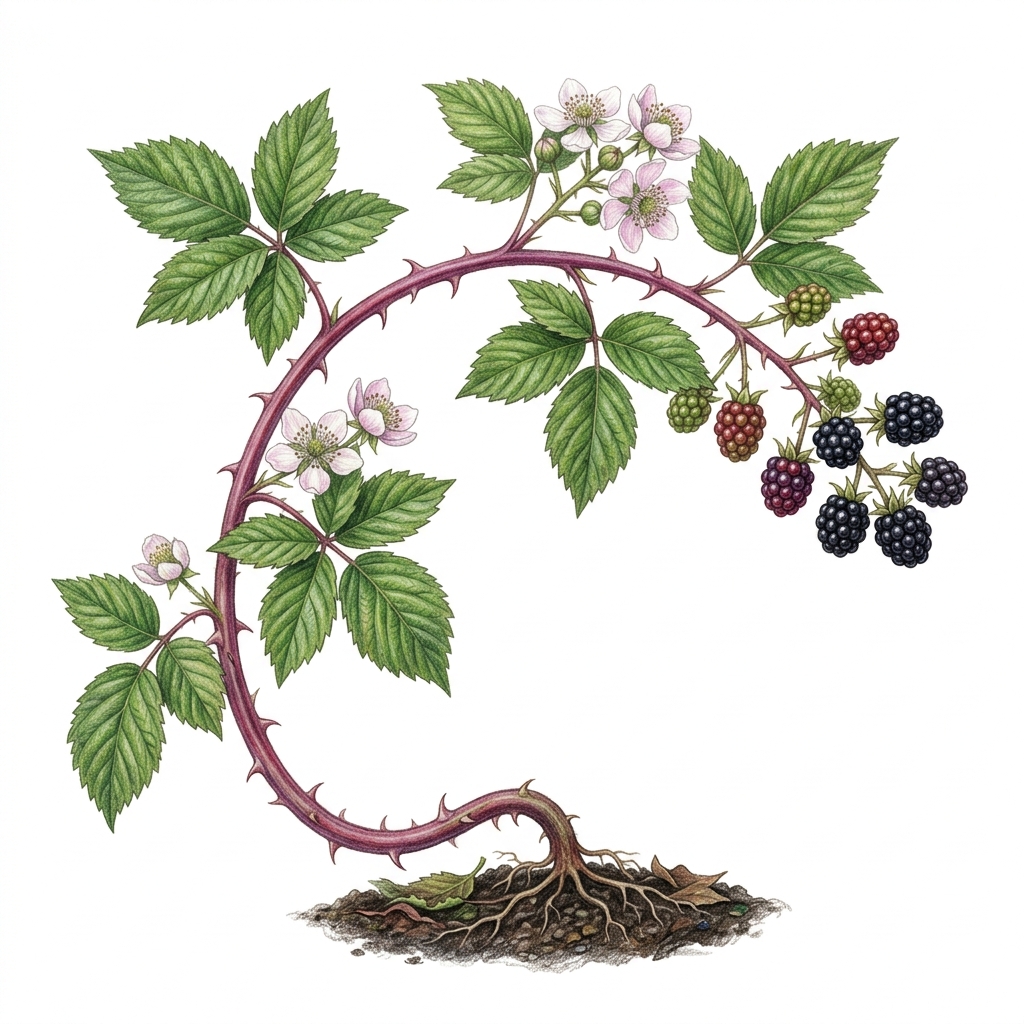
Illustration
Thorny, arching canes that form dense thickets, with white-to-pink flowers and black berries. Cutting alone just makes it regrow: the crown and roots have to come out, and in Australia it's a Weed of National Significance.
How to spot it
- Arching, angled, reddish-purple canes covered in curved prickles, often several metres long.
- Leaves divided into three to five (usually five) toothed leaflets spread like a hand, dark green above and paler underneath, with hooked prickles on the midrib.
- White or pink five-petalled flowers, 2–3 cm across.
- Berries that turn green, then red, then black; a ripe berry stays on its core when picked.
- Cane tips that arch down and root where they touch the soil.
Easily confused with
Native raspberry (Rubus parvifolius, Australia)
Red fruit about 1 cm across that comes away from its core, and mostly three leaflets with white felt underneath. It's a native that has been pulled out by mistake.
Rose-leaf bramble (Rubus rosifolius, Australia)
Five to seven leaflets arranged along a central stalk like a feather, not spread like a hand.
Molucca bramble
Single lobed leaves, not divided into leaflets.
Where it's a problem
- Australia: A Weed of National Significance covering about 9 million hectares. It must not be sold in NSW (some thornless cultivars are exempt), is a restricted invasive plant in Queensland, and is declared in Tasmania.
- New Zealand: Under regional control; in Hawke's Bay, occupiers can be directed to clear it within 10 m of a boundary.
- United Kingdom: Native and unregulated; it supports nearly 100 kinds of moth.
- North America: Himalayan blackberry is a listed noxious weed in Washington and Oregon.
- Southern Africa: A listed invasive species under South Africa's biodiversity law.
What to do
- Check for nesting birds first, and wear thick gloves and long sleeves.
- Cut the canes down to about 30 cm so you can reach the base.
- Dig out the crown and as many roots as you can: root pieces regrow.
- Pull seedlings as they appear in spring, and mulch the cleared ground about 7.5 cm deep.
- Keep watching for regrowth for several years. Slashing or burning alone won't kill it, and digging over the soil can spread it.
If you use a herbicide, choose one labelled for blackberry and follow the label and local rules. Official guides treat spraying as one part of a longer programme, and Tasmania advises against spraying plants that are carrying fruit.
Follow your local council's guidance for disposing of weeds. Councils usually advise against putting weeds like this in the green waste / vegetation bin or the compost.
Take care: Sharp prickles: wear thick gloves.
Free account, no card needed. You sign up or sign in first, then the scanner opens.
Sources
- NSW DPI WeedWise: Blackberry
- Weeds Australia: Blackberry
- Business Queensland: Blackberry
- NRE Tasmania: Blackberry
- PlantNET: Native raspberry (Rubus parvifolius)
- RHS: Brambles and other woody weeds
- Hawke's Bay Regional Council: Blackberry
- King County, Washington: Himalayan blackberry
Facts checked Sunday 27 September 2026. General guidance only: follow your local council, agency and product label.