Home › Weed guide › Bindii
Weed guide
Bindii
Soliva sessilis · Daisy family (Asteraceae)
Also called jo-jo (Australia), Onehunga weed (New Zealand), lawn burweed (USA).
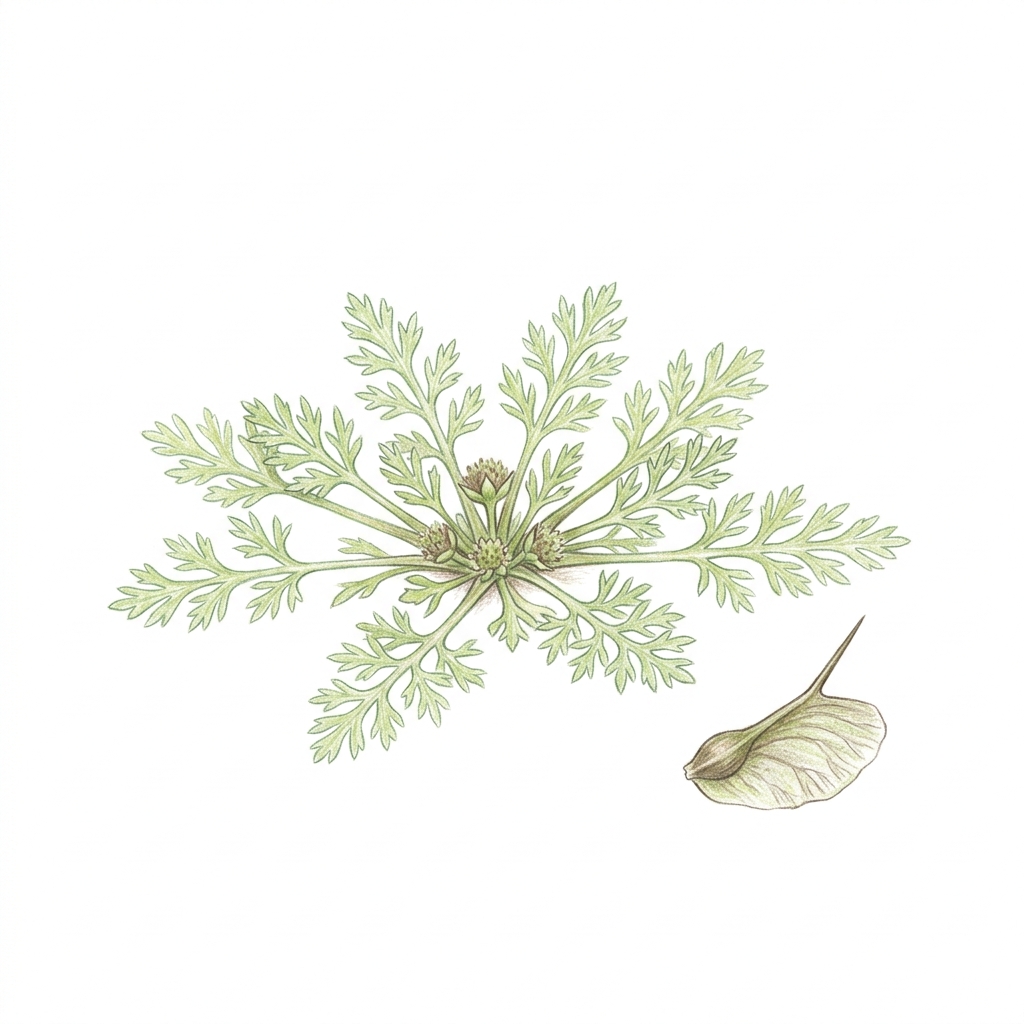
Illustration
The low, feathery lawn weed behind those painful prickles in bare feet. It grows through winter and sets its spiny seeds in spring, so the time to act is before the prickles form.
How to spot it
- A flat patch hugging the ground, about 5 cm tall and usually up to 15 cm across.
- Feathery, parsley-like leaves cut into narrow segments, 1.5–5 cm long and slightly hairy.
- Tiny greenish flower heads with no petals, sitting tight in the plant at ground level.
- In spring, flat winged seeds, each tipped with one sharp spine: the prickle you tread on.
- Stems often have dark or purple spots.
Easily confused with
Caltrop (Tribulus terrestris)
Also called bindii in parts of Australia, but it has yellow flowers, leaves made of paired leaflets, and a hard woody burr that breaks into five spiny pieces. It is a declared weed in some Australian states.
Soldier's button (Cotula australis)
Its small brown button-shaped seed heads are easy to see, where bindii's flowers hide flat in the plant.
Pineappleweed
Hairless leaves and easy-to-see, cone-shaped yellow-green flower heads that smell of pineapple when crushed.
Where it's a problem
- Australia: Common in lawns, parks and paths in every state.
- New Zealand: Known as Onehunga weed, and one of the most disliked lawn weeds in the country.
- USA: A lawn weed in California and the South East; a Class C noxious weed in Washington State.
What to do
- Act in winter, while plants are small and before the prickly seeds form in spring. Dead plants still carry their prickles.
- Hand-pull or dig out small patches after rain, when the soil is soft, taking the whole plant.
- Grow a thick lawn: feed it, mow at the right height for your grass and water it well. Bindii struggles to get going in dense turf.
- Aerate compacted areas and paths, where it thrives. Badly infested patches can be replaced with new turf.
If you use a herbicide, choose one labelled for bindii and follow the label and local rules. Spray while plants are young in winter: once the spines form it is much harder to control, and older plants may need a second treatment.
Follow your local council's guidance for disposing of weeds. Councils usually advise against putting weeds like this in the green waste / vegetation bin or the compost.
Take care: The sharp seed spines can pierce skin and stick in bare feet and pets' paws.
Free account, no card needed. You sign up or sign in first, then the scanner opens.
Sources
- University of California IPM: Lawn burweed
- Clemson University HGIC: Lawn burweed
- PlantNET, Royal Botanic Garden Sydney
- Massey University: Onehunga weed
- Washington State Noxious Weed Control Board
- Weeds Australia: Caltrop
Facts checked Sunday 27 September 2026. General guidance only: follow your local council, agency and product label.