Home › Weed guide › Alligator weed
Weed guide
Alligator weed
Alternanthera philoxeroides · Amaranth family (Amaranthaceae)
Also called alligatorweed (USA).
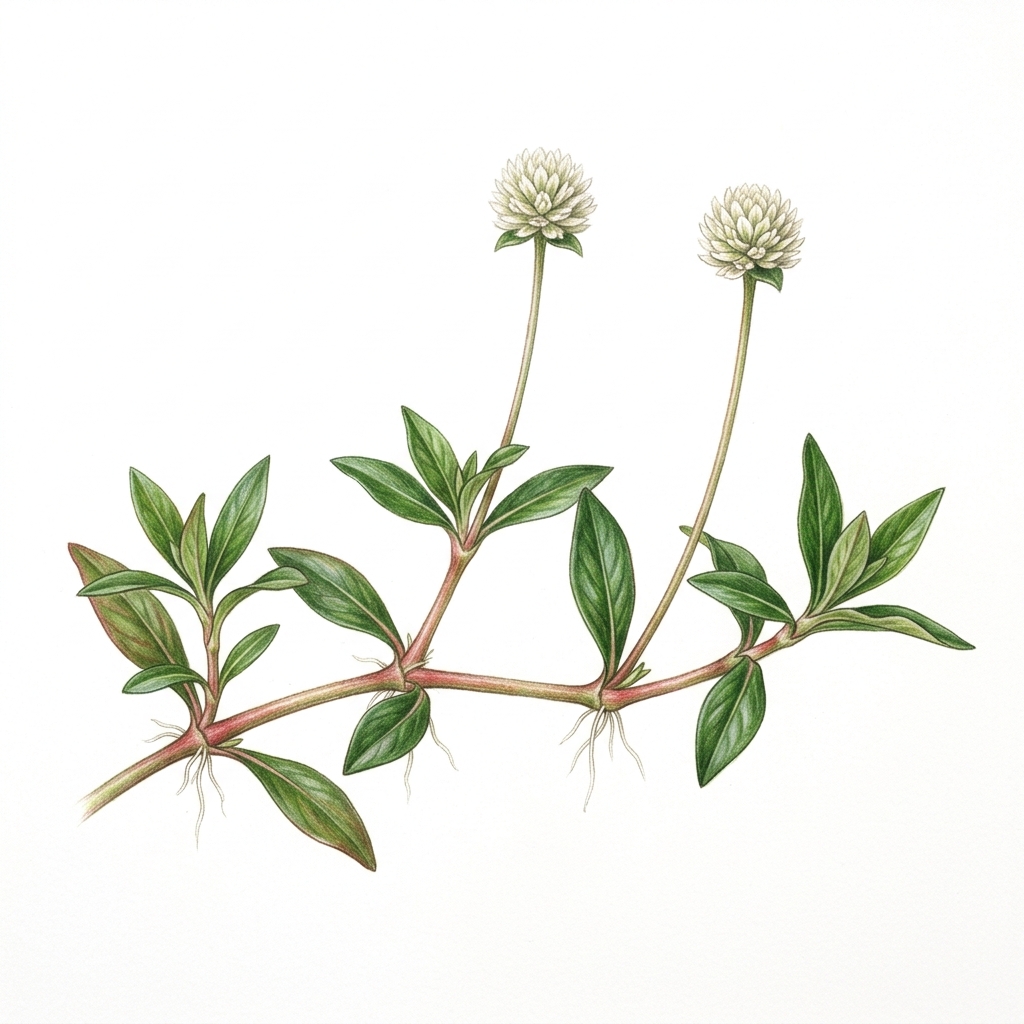
Illustration
A soft, mat-forming weed of waterways and damp ground that regrows from the tiniest piece of stem. Authorities ask you not to pull it: if you think you've found it, report it.
How to spot it
- Leaves in opposite pairs, glossy and spear-shaped, 2–7 cm long, with smooth edges and no leaf stalk.
- In summer, small white papery flower heads like a clover ball, about 1 cm across, each raised on its own stalk 2–7 cm long.
- Soft, often reddish stems that root at the joints and form tangled mats on damp ground or floating on water.
- Stems growing in water are hollow; on dry land they can be solid, so don't rely on the stem alone.
- It is a soft, sprawling herb, never a woody shrub.
Easily confused with
Lesser joyweed and sessile joyweed (Alternanthera denticulata, A. sessilis)
Their white flower heads sit tight in the leaf joint with no stalk; alligator weed's are raised on a stalk. Lesser joyweed is an Australian native.
Privet (seedlings and cuttings)
Privet is a woody shrub with firm, woody twigs. Alligator weed is a soft herb whose stems root where they touch the ground.
Water primrose (Ludwigia)
Leaves grow one at a time along the stem, not in pairs, and the flowers are bright yellow.
Where it's a problem
- Australia: A Weed of National Significance, declared in every state and territory. In NSW it must not be sold or traded; Victoria lists it as a State prohibited weed; in Queensland it is a restricted invasive plant that must not be given away, sold or released.
- New Zealand: An unwanted organism under the National Pest Plant Accord: it must not be bred, distributed, released or sold. Regional councils manage it.
- USA: A listed noxious weed in several southern states, including California and Florida.
- European Union: Listed as an invasive alien species of Union concern since 2017.
What to do
- Don't pull, dig, mow or slash it. Pieces as small as a stem joint grow into new plants, and authorities warn that poor control can spread it.
- Report it: in Australia to your local council or state weed agency, in New Zealand to your regional council, and in the USA to your state agriculture department. They can confirm what it is and advise.
- Until then, keep mowers, vehicles and boots off the patch, and don't move soil, turf or plants from it.
- After treatment, check the spot regularly: regrowth from roots is common.
Treatment is best left to your council or a licensed contractor. Control usually takes repeat treatments through the growing season, and authorities advise against trying it without expert help.
Follow your local council's guidance for disposing of weeds. Councils usually advise against putting weeds like this in the green waste / vegetation bin or the compost.
Take care: It is thought to cause sun-sensitivity (photosensitisation) in light-coloured cattle, and thick mats on water are a hazard to swimmers.
Free account, no card needed. You sign up or sign in first, then the scanner opens.
Sources
- NSW DPI WeedWise: Alligator weed
- Weeds Australia: Alligator weed
- Business Queensland: Alligator weed
- PlantNET, Royal Botanic Garden Sydney
- Auckland Council: Alligator weed
- US National Invasive Species Information Center
- Florida Department of Agriculture: Alligator weed
Facts checked Sunday 27 September 2026. General guidance only: follow your local council, agency and product label.